
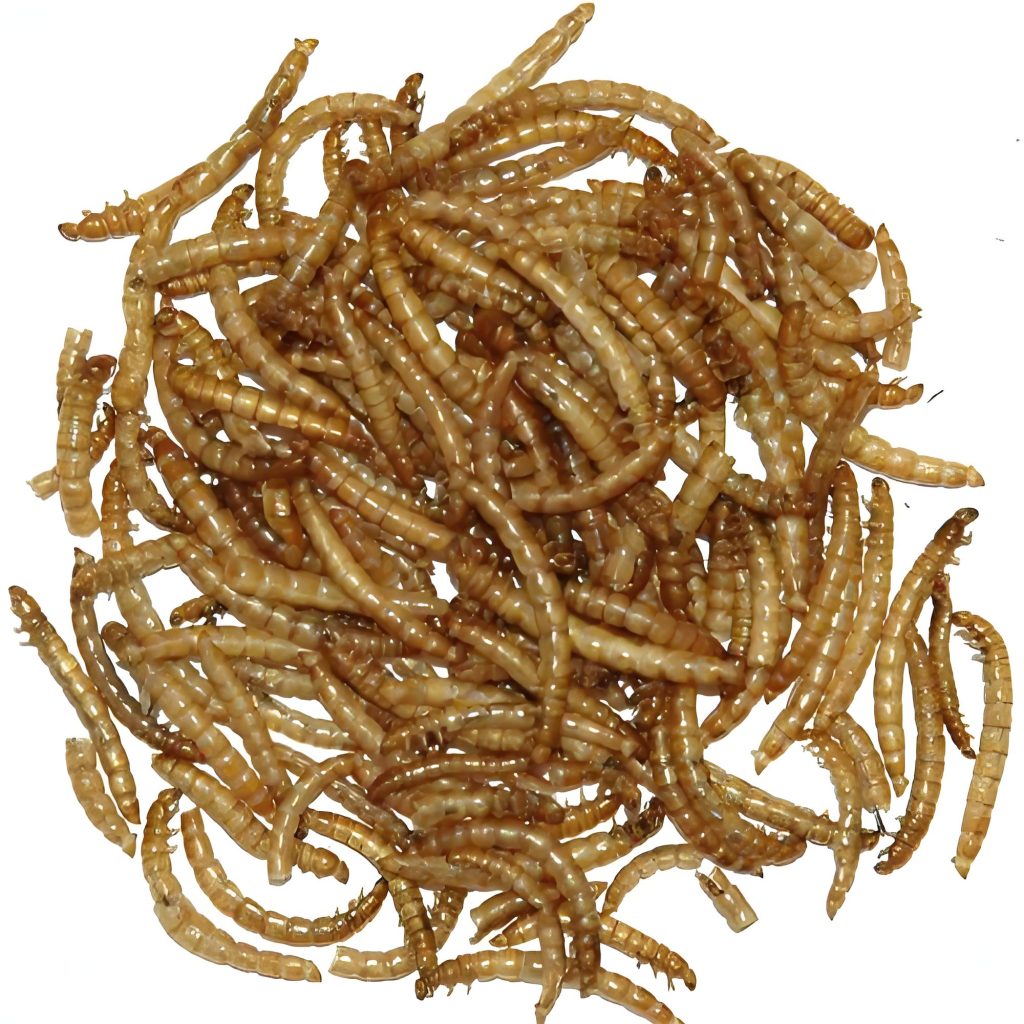
For feed mills, pet food manufacturers, aquaculture operations, and livestock farms, dried mealworms have become an essential choice as a premium protein ingredient. However, quality varies widely across suppliers. How do you select consistently high-quality dried mealworms that are safe and meet your production needs? This guide walks you through everything from sourcing and sensory evaluation to nutrition, processing, certifications, and storage.
1. The Starting Point: Sourcing and Processing
High-quality dried mealworms start with their source and how they’re processed. Farm-raised mealworms (Tenebrio molitor, also known as yellow mealworms) must be grown under controlled conditions, with strict oversight of their feed — because contaminant levels in mealworms largely depend on the safety of what they eat. Reputable suppliers implement standardized management practices, including “unified breeding, unified feeding, unified management, and unified processing,” to ensure quality at every stage.
2. Sensory Evaluation — What Your Eyes and Nose Can Tell You
A simple sensory check can tell you a lot about quality:
-
- Color: High-quality dried mealworms have a uniform golden-yellow to light tan appearance. Significant darkening, spotting, or discoloration usually indicates degradation or poor storage conditions. Mold growth is a clear sign of severe spoilage — reject such products immediately.
-
- Odor: Fresh, high-quality dried mealworms have a mild, nutty aroma. A rancid, musty, or ammonia-like smell means they have gone bad and should not be used.
-
- Texture: Dried mealworms should be crisp and firm. Stickiness, clumping, or excessive brittleness (too much powder) suggests moisture absorption or improper processing. Also check for live insects or signs of infestation — these indicate packaging damage or poor warehousing.
-
- Foreign Matter: Premium products should contain no visible foreign matter — no grit, stones, insect droppings, dead insects, or metal fragments. Routine sample inspection for impurities is strongly recommended.
3. Nutrition — Consistency and Transparency Matter
Dried mealworms are valued for their exceptional nutritional density. Typical crude protein content ranges from 45% to 52%, with crude fat between 20% and 28%. High-quality dried mealworms also provide a complete amino acid profile.
For business buyers, what truly matters is whether your supplier provides consistent, verifiable guaranteed analysis. Reputable suppliers clearly label key values — crude protein, crude fat, crude fiber, and moisture — on their product packaging or documentation. Moisture content deserves special attention: quality dried mealworms typically have moisture levels below 8%. Excessive moisture significantly shortens shelf life and increases the risk of mold growth.
Also pay attention to ash content and calcium-to-phosphorus ratios — these directly impact pet food and animal feed formulations. When third-party lab testing isn’t available, sensory evaluation combined with supplier credentials offers a solid basis for judgment.
4. Industry Standards and Certifications — The Professional’s Badge of Trust
Whether your supplier meets industry quality standards directly determines product safety and batch-to-batch consistency. On April 30, 2023, China’s “General Rules for the Quality of Dried Tenebrio molitor” (Standard No. T/OTOP 1023-2023) was officially released and implemented — the country’s first group standard establishing quality requirements, inspection rules, labeling, and packaging specifications for dried mealworms. This standard applies to dried mealworms produced from farm-raised mealworms through harvesting, filtering, washing, and drying. Give priority to suppliers who follow this standard.
On the production side, verify that your supplier holds key quality and food safety certifications, including ISO 9001 (Quality Management), ISO 22000 (Food Safety Management), and HACCP (Hazard Analysis and Critical Control Points). In the pet food and animal feed space, GMP+, FSSC 22000, and FDA registration are also strong indicators of professional capability.
Export-focused businesses should pay particular attention to destination market regulations. International regulations governing insect protein for animal feed are becoming increasingly stringent worldwide. Suppliers with relevant international certifications have already passed more rigorous testing on both their products and production processes.
5. Shelf Life and Storage — The Second Half of Quality
Even the best dried mealworms will degrade quickly if stored improperly. Generally, heat-dried mealworms have a shelf life of about one year in cool, dry conditions, while freeze-dried mealworms can last five years or more.
-
- Storage Conditions: Keep in a cool, dry, dark place — ideally below 70°F (21°C).
-
- Packaging: Use airtight containers (resealable bags or plastic/glass containers with tight-fitting lids) to prevent oxidation and moisture absorption.
-
- Discard at the first sign of off-odors, mold, clumping, or pests. Do not use spoiled mealworms in feed production.
6. Key Applications
Dried mealworms are widely used across multiple sectors:
-
- Livestock & Poultry: Added to feed for laying hens, broilers, quail, and pigs to improve growth performance and protein utilization.
-
- Pet Food: Used as a novel protein source in dog and cat food — particularly suitable for pets with sensitivities due to its hypoallergenic properties. Also fed directly to reptiles, ornamental fish, hamsters, and other small pets.
-
- Aquaculture: Added to fish feed as a protein supplement to support growth rates and disease resistance.
-
- Specialty Animal Feeding: Widely used for birds (especially wild birds) and reptiles as part of daily feeding regimens.
7. How to Choose a Reliable Supplier — Key Factors to Evaluate
When evaluating dried mealworm suppliers, consider the following dimensions:
-
- Full Supply Chain Control: Quality suppliers typically control the entire chain — from breeding and farming to processing and sales — ensuring consistent quality at every stage.
-
- Production Capacity: For bulk purchasing, ensure your supplier has the capacity to maintain reliable, uninterrupted supply.
-
- Traceability and Transparency: Suppliers should provide clear batch information, test reports, and a fully traceable quality system.
-
- Industry Experience and Track Record: Suppliers with a history of serving established domestic or international clients — or with export experience — generally have more mature quality management systems.
-
- Reliable After-Sales Support: Including technical consultation, usage guidance, and responsive quality issue resolution.
Final Thoughts
Choosing dried mealworms is far more than comparing prices — it’s an assessment of your supplier‘s end-to-end supply chain control and commitment to quality. High-quality dried mealworms must not only deliver strong nutritional metrics but also be safe, consistent, and fully traceable. As a professional manufacturer of dried mealworms, we understand the quality responsibility that comes with every batch — and we look forward to building long-term, trust-based partnerships with like-minded business customers.
